
Friday, February 6, 2015
The Wonderful World of Whiskey in One Inforgraphic!

Morning Paradise

Imagine sitting on the beach, and the sun is slowly coming over the horizon. The day is slowly beginning. That is the image that I am trying to provoke with the Morning Paradise.
The Morning Paradise is sweet creamy cocktail that combines coconut, spiced rum, and coffee. In the morning, coffee is a necessity. However if I am sitting on a sandy beach on vacation, I would like to have my coffee spiked with something. When thinking of paradise, images of the tropics and beaches keep on flooding my mind.

45ml of Sailor Jerry Spiced Rum
2 bar spoons of coconut cream powder
2 dashes of vanilla oil
10 ml of agave syrup
25 ml of coffee
25 ml of cream
Pour the ingredients in a mixing tin.
Fill with ice.
Shake.
Strain into a chilled cocktail glass.
Garnish with coconut cream powder and cinnamon.
Enjoy!
Monday, September 29, 2014
How grand is the Grand Kirin??

Recently, Kirin Brewing has been releasing new beers in its Grand Kirin series of beers. The Grand Kirin is the premium offering from Kirin. It utilizes the exclusive "dip hop" process that Kirin developed specifically for this beer. Grand Kirin is in direct competition with Suntory's Premium Malts, Sapporo's Yebisu, and Asahi's Super Dry Premium (a recent release from Asahi). In a time in which beer sales have been on a recent decline in Japan, is it the right time for a push for a premium beer? Kirin Brewery is world renowned for its Ichiban beer. Also, many older Japanese people are nostalgic for Kirin's lager and Classic beers. So, it is time for a review of the Grand Kirin beers. Are they worth purchasing and drinking? This review will cover the six beers in the Grand Kirin line: The Aroma, Browny, Hop Fruity, Mild Rich, and the Original Grand Kirin. Cheers! (乾杯!)

Grand Kirin The Aroma
Style: Golden Ale
ABV: 5.5%
Bravo Hops
Color: golden
yellow with a white head
Nose: floral
with a slight hint of citrus
Taste: malty
and somewhat bitter hoppy taste
Grand Kirin The Aroma is a decent beer that is readily
available at most convenient stores in Japan. It is a smooth dry beer with a somewhat bitter hoppy
flavor. It is a premium version of
the mainstay Kirin Ichiban. The
slight citrus notes are noticeable with drinking this beer.

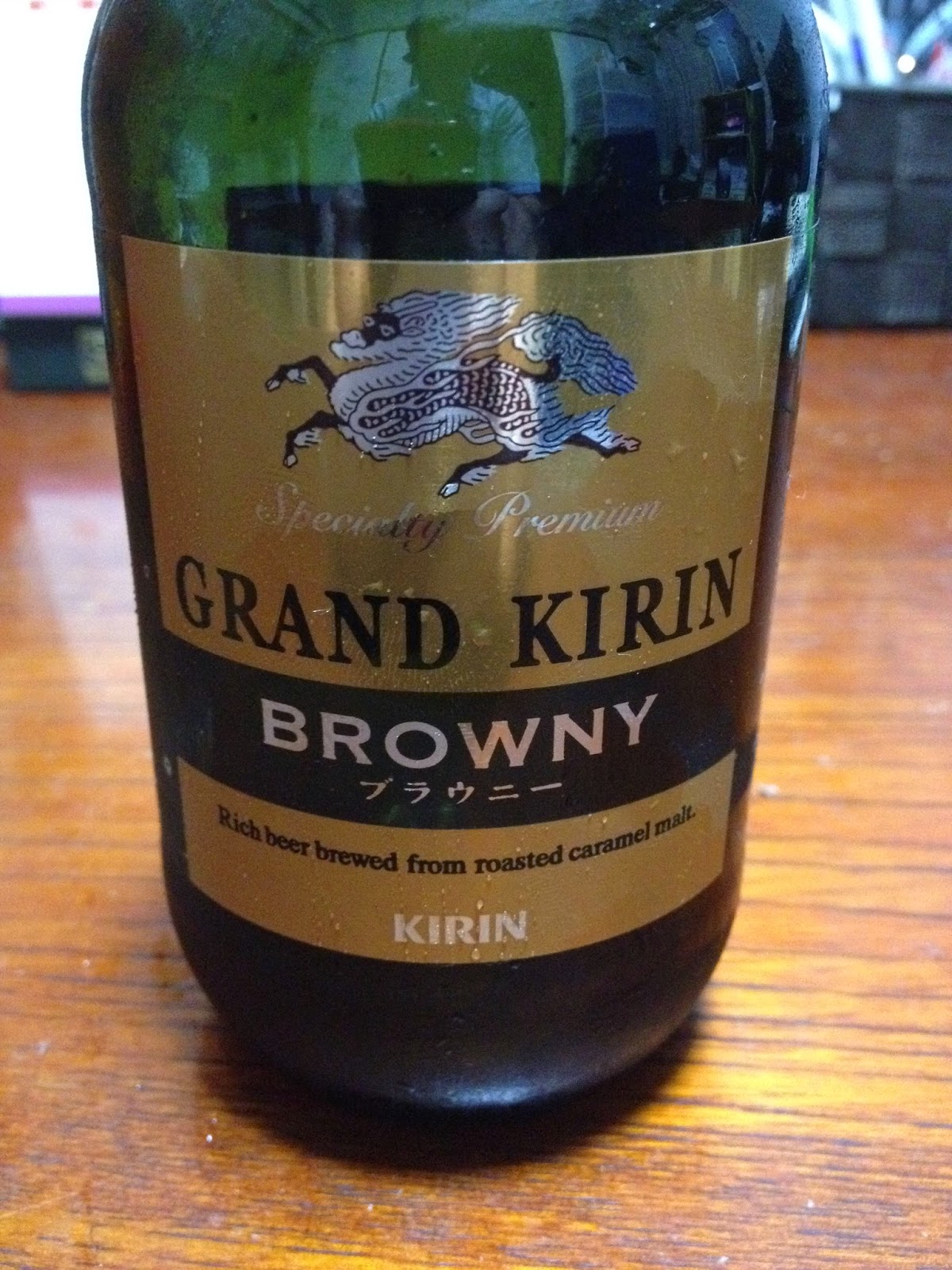
Grand Kirin Browny
Style: Amber Ale
ABV: 6.5%
Czech Hops
Roasted
Caramel Malt
Color: a light
copper brown with an off-white head
Nose: slight
caramel notes
Taste: smooth,
slight caramel malty taste
Grand Kirin Browny is a decent attempt at a brown ale from a
macro brewery. It is a light
smooth beer with roasted caramel notes found throughout the beer. This is a trying to be a traditional
Japanese brown ale in that the flavors are not completely overpowering but are
noticeable.

Grand Kirin Hop Fruity
Style: American
Pale Ale
ABV: 5.5%
Nelson Sauvin Hops
Color: pale
orange yellow with a white head that dissipates quickly
Nose: slight
citrus and vegetal notes
Taste: slight
hop flavor coming the Nelson Sauvin Hops
smooth yet sweet flavors
coming from the malt
Grand Kirin Hop Fruity is the latest release in the Grand
Kirin line. As of this review, it
is an exclusive at Family Mart.
This beer tries to be an American pale ale, but it misses the mark. However coming from a macro brewery, it
a decent major label beer that is trying to be different. The hops need to be a little more
pronounced in it, and this will help to counteract the sweetness from the
malts.


Grand Kirin Mild Rich
Style: Wheat Ale (Weizen)
ABV: 5.5%
Galaxy Hops
Color: Pale
golden color with a white head
Nose:
Fruity citrus notes with an orange and wheat presence
Taste: Creamy
bready slight medium carbonated body with some hops
popping in the
background
Grand Kirin Mild Rich is an exclusive beer that can be found
in Lawsons. They also have a
special twin pack with Grand Kirin (the original) and Grand Kirin Mild
Rich. The Mild Rich is good
attempt at a wheat beer. The
classic characteristics of orange and wheat that are typically found in wheat
beers are found here, but they have a underwhelming presence. This is a smooth medium body beer with
citrus notes in the background.

Grand Kirin (the original)
Style: Premium Lager
ABV: 6%
Color: golden
amber with a white head that dissipates quickly
Nose: sweet
malty aroma
Taste: sweet
malt taste with a light crisp body
This is the first beer that Kirin released in its Grand
Kirin line. Its is a light crispy
malty lager. There is a lot of
carbonation found in this beer.
Compared with the Kirin Lager, the Grand Kirin is smoother and less
dry. It is a decent lager but
nothing worthwhile.
For more information on the Grand Kirin line, check out http://www.kirin.co.jp/products/beer/grandkirin/
Tuesday, September 23, 2014
Japanese Craft Beer Series: Visiting Monster Island with Kaibutsu-jima Beer (かいぶつ島ビール)!

On a recent trip to my local liquor store near my work, I was looking for something to get the night start on the right foot. When looking through the beer case, I found this beer. I was intrigued by it at first because I have never seen before. Then, I looked at the label to find out where this beer was from. I was surprised to learn that the beer was brewed in Tsushima. I did not even know that Tsushima had a brewery. I was very curious to find out how this beer tasted. So, I decided to buy it. I am always looking for a new beer to try especially from the local area.

I give a lot of credit to Tsurumi Brewing for releasing this beer to the public. I am always trying to find beers from small breweries as opposed to those released from the major breweries. If you can find this beer, give it a try. It is a decent beer.
For more information regarding Tsurumi Brewing, check out http://www.tsurumi-jp.com/index.html
Saturday, May 3, 2014
Drink like the Monarchy with the Zaza aka Dubonnet Cocktail!


Why does this cocktail have two names: the Dubonnet cocktail and the Zaza cocktail? If this drink is served up rather then being on the rocks, the name of the drink becomes the Zaza. The name Zaza comes from the name of a popular French play which was a hit on the verge of the 20th century. The play was later made into movies and musicals. Zaza is also a diminutive of Isabelle. However there is nothing diminutive of the Zaza.
Dubonnet is the key ingredient in this drink. There is no substitution for the Dubonnet. Dubonnet is a fortified wine made from wine, herbs, and spices (including quinine). Dubonnet was created in 1846 France. The French needed something to give their French Legionnaires who were fighting in North Africa at the time. Quinine is a popular remedy to fight malaria. However, it is very bitter. So, Dubonnet was created. It's also the same reason for the creation of the classically popular Gin and Tonic.
Gin is the other major ingredient in this drink. The botanicals in the gin compliment the Dubonnet. The addition of the orange bitters gives the drink a complex citrus bite and fragance to the drink. The drink becomes a refreshing drink when served on the rocks. When served up, the cocktail becomes an elegant aperitif. Either way the Zaza is great way to drink like a monarch.


Zaza aka Dubonnet Cocktail
1 1/2 oz of gin
3/4 oz of Dubonnet Rogue
2 dashes of orange bitters
Pour the ingredients into a mixing glass.
Fill the mixing glass with glass.
Stir for mixture for about 15 to 30 minutes to achieve proper chillness and to dilute the drink.
Strain into a chilled cocktail glass.
Enjoy
Cheers
Celebrating Spring Time and the Kentucky Derby: Mint Julep!


The mint julep has a long storied history in the annals of American drinking history. There are references of the mint julep being made in the 1700's around Maryland, Virginia, and North Carolina. The first time that the mint julep was seen in print happened in 1803. A British author penned the mint julep as "a dram of spiritous liquor that has mint in it taken by Virginians in the morning". In fact, the mint julep was referred to as a type of medicine. The French word "julep" is derived from the Persian "gulab", a sweet concoction that may have been a vehicle for medicine. It is also to important that the first mint juleps were not made with bourbon whiskey. Instead, there were commonly made with rum or rye whiskeys.
For a long time, Kentucky bourbon whiskey was not commonly distributed until later in the 19th century. The first mention of a mint julep in Kentucky was written in 1816 in the Kentucky Gazette. The article mentioned that the mint julep cups were offered as prizes at horse race events. We do not know when Kentucky bourbon was first used in a mint julep, but nowadays bourbon whiskey is the common spirit for a mint julep. Legend has it that the mint was grown outside the the club house of Church Hill Downs in Louisville so that it can be used in mint juleps at the first Kentucky Derby in 1875.
When making the mint juleps, there are some essential things to remember. Use fresh mint when making the drink because when mint gets old and stale, it loses it flavor and becomes bitter. Also, crushed ice is essential when making this drink. The mint julep is meant to be sipped over time. The crushed ice allows the drink to keep cold and refreshing. If you were using cracked ice or ice cubes, the drink will become warm over a period of time. The other thing to consider when making a mint julep is the vessel that the drink will be served in. At the Kentucky Derby, mint juleps are drunk from silver cups. The silver cup tends to keep the drink colder. However, most people do not silver cups at home. So, use an Old-fashioned glass.
Mint juleps are ideal to drink on Derby Day (May 4th) or anytime for that matter. Mint juleps are becoming recently unpopular due to changing tastes and many bars and restaurants do not know how to make a proper one. Personally, I enjoy the sweetness of the mint and sugar with the strong smooth taste of the whiskey.


Mint Julep
2 oz of bourbon whiskey
2oz of simple syrup
10 sprigs of mint
Crushed ice
At the bottom of the glass, place at least 7 sprigs of mint, simple syrup, and the bourbon whiskey. Muddle the mixture. DO NOT over muddle or the mint will become bruised and bitter. Fill the glass halfway with crushed ice. Mix the mixture and the mixture. Top with more crushed ice until it comes up to the rim of the glass. Served with a straw and few mint sprigs. Before garnishing the glass, grab the mint and slap the mint with hands in order to bring the essential oils that are found in the mint. Enjoy
Cheers
Thursday, May 1, 2014
An Offer You Can't Refuse: the Godfather!

The Godfather combines the bittersweet Italian almond liqueur Amaretto and the smoky complex bite of scotch whiskey. This drink was created in the 1970's in the USA. According to the popular amaretto maker, Disaronno, the Godfather was one of Marlon Brando's favorite drinks. Marlon Brando is world renowned for his role in the Italian mobster movie, The Godfather.
The Godfather is a popular drink for those who are looking for something strong yet sweet. The amaretto plays a major role in the drink because it tends to soften the bite of the whiskey. Scotch whiskey for some people tend to rather strong in flavor. The bittersweet character of the amaretto plays well with whiskey while giving the drink a distinct nose. The nose of the Godfather is sweet, nutty, woody, and a little smoky. For the scotch whiskey, I would recommend using a blended scotch as opposed to a single malt. The depth of flavor that tends to be found in single malts would get lost in the mix. I am using Ballatine's in this drink, but please feel free to use your favorite blended scotch.
It's perfect on those long nights relaxing at home or for an aperitif. It's a relaxing yet elegant drink.


Godfather
35 ml of scotch whiskey
35 ml of amaretto
Fill an Old-fashioned glass with ice.
Pour the scotch and the amaretto over the ice.
Stir to combine the ingredients.
Enjoy!
Monday, April 21, 2014
Italian Stallion

Last year, Jim Beam released a line of delicious flavored
bourbons. There is Red Stag Honey,
and Spiced flavored bourbons. In
Japan, however, they are sometimes hard to find in the stores especially to the
black cherry version. The honey
and spiced varieties can be found at some liquor shops, while, the black cherry
can be found at a select few. One
day, I went to my favorite liquor store, and I saw that they had a bottle of
the Red Stag Black Cherry. I decided
to pick it up and try it at home.
I believe I made a wise decision.
Red Stag Black Cherry by Jim Beam is delicious. The sweet cherry flavor is blended well
with the bourbon to give it a sweet oak flavor. Bourbon whisky already starts off with a sweet vanilla woody
flavor due its brewing and aging process.
The burnt oak barrels that bourbon makers specially use give their
whisky a distinct flavor that can only be found in bourbon. The combination of sweet black cherry
with the rich vanilla oak flavor of the bourbon is outstanding.
In the last couple of weeks, I have been trying to use
amaretto in new ways. The Italian
liqueur brings a distinct bittersweet almond taste and bouquet to most
drinks. One day, an idea conjured
up in my head: what if I combined the elegant bittersweet nature of the
amaretto with the Red Stag Black cherry bourbon? I decided to give it a try. That is how I came up the idea of the Italian Stallion.
The Italian Stallion can be prepared in two styles: on the
rocks or in a shot. Which style do
you make depends on why you are serving the drink? The Italian Stallion shot will bring the sweetness nutty
taste of the amaretto with vanilla cherry wood taste to your mouth in an
instant. It is a rush of flavors
that your mouth will be happy about.
On the other hand, the Italian Stallion cocktail will intertwine the
distinct bouquets of the amaretto and Red Stag Black Cherry together. The nose of the drink is rather
intoxicating.
Italian Stallion: The Shot


20 ml of Red Stag Black Cherry Bourbon
20 ml of Amaretto
Pour the amaretto and the Red Stag Bourbon into the shot
glass.
The two alcohols will layer
in the glass giving the drink a distinctive look
Italian Stallion: The Cocktail


30 ml of Red Stag Black Cherry Bourbon
30 ml of Amaretto
Fill an Old-fashioned glass with ice. Pour the amaretto and Red Stag bourbon
into the chilled glass. Stir the
cocktail gently in order to allow the aromas of the bourbon and the amaretto to
live the glass.
Saturday, April 19, 2014
French Connection

Recently, I have been becoming more and more a fan of
amaretto. I enjoyed amaretto
before, but recently I have been finding myself making more and more drinks
with it. The sweet nutty flavor of
the amaretto has been intoxicating.
I have been looking through my different liquor recipe books to find new
recipes. That is how I found out
the French Connection cocktail.
It seems that the history behind the French Connection drink
is lost in the annals of history.
However when you take a look at the ingredients, it is somewhat easy to
see the connection. The French
contributed to the drink with the addition of cognac, while, the Italians added
amaretto.
The French Connection conjures up images of men smoking
cigars, wearing fedoras, and looking cool and dapper. This drink epitomizes coolness. It is a simple yet sophisticated. In the recent months, it has become of my favorite
nightcaps.
The French Connection comprises of two ingredients: cognac
and amaretto. When making this
drink, I suggest using a good aged cognac like a VSOP. VSOP stands for Very Superior (Special)
Old Pale. For a cognac to receive
this designation, it has to aged for 4 to 6 years. A VSOP will give the drink a deeper richer flavor to the
drink. The other main ingredient
of the French Connection is amaretto.
Amaretto is an Italian liqueur that is made from almonds and/or apricot
pits. Amaretto is
bittersweet. It has a unique sweet
bouquet which will be present in this drink. The combination of cognac and amaretto is complex yet
simple. The warming cognac will
blend well into the distinctive nutty flavor of the amaretto.


French Connection
30 ml of a good quality cognac (a VSOP would work nice)
30 ml of amaretto
Fill an Old-fashioned glass with ice.
Pour the cognac and amaretto into the chilled glass.
Stir a few times gently to dilute the drink and for the
bouquets of the cognac and the amaretto to be released from the glass.
Serve.
Cheers!
Wednesday, April 16, 2014
Hunter
During the fall season,
the temperature is slowly dropping; the air is getting cooler and crisper; the
nights are getting longer. The
hunters are out in the forests and the mountains looking for their prey.

The Hunter’s Cocktail was crafted in
order to invoke to this image.
When pouring the different cocktail books, magazines, and websites,
there are two names that are commonly found with this drink. One name is the “Hunter’s Cocktail”. The other name is “Hunter”. I am particular fond of the name “Hunter”
because it brings the image that was described above to the forefront. “Hunter” invokes notions of masculinity
when heard. It is not surprising
to hear this when looking at its ingredients.
Hunter is a combination
of rye whisky and cherry brandy.
Rye whiskies typically bring a drier, smoky, and spicier note to
drinks. I have, also, seen this
drink made with bourbon whisky.
Bourbon whisky seems fitting to this drink because bourbons bring sweet,
rounder notes to drinks. However
when tasting this drink with bourbon, the bourbon tends to make this drink
sweeter and richer. It’s a little
too rich for my taste. I find that
the rye whisky brings a balance to the other ingredient in this drink, the
cherry brandy.
If the whisky brings
the image of the mountains, forests, and the outdoors to the drink, the cherry
brandy brings the blood to the drink.
When someone says the word “hunter” or “hunting”, the first image that
comes to mind is blood. Cherry
brandy is not an overtly sweet liqueur.
It has a distinctive dry characteristic to it. For me, it is a cross between a dry Curacao and a sweet
liqueur. The little dryness that
the cherry brandy contains is the great complement to spicy, dry notes that are
found in the rye whisky. However
with that being said, the cherry brandy can overpower the drink.
The measurements in this drink
are really according to your taste.
How do you like drinks, a little sweet? a little spicy? For me, I find a proportion of 1 part
rye whisky to one-half part of cherry brandy does the trick. This strikes a nice balance to the
drink.


Hunter
40 ml of rye whisky (Old Overholt)
20 ml of cherry brandy (Suntory’s Hermes Cherry Brandy)
Pour the ingredients into a mixing glass.
Fill the mixing glass with glass.
Stir the drink until the drink is cold and diluted to your
tastes.
(I typically stir it for
30 seconds.)
Strain the mixture into a chilled cocktail glass.
Enjoy!
Sunday, April 13, 2014
Sakura
Spring is in the air. It is time to celebrate to the springtime with a light refreshing cocktail. There are many places notably Japan where the cherry blossoms are blooming.

This cocktail was inspired by the blooming pink flowers that are growing everywhere. People enjoy watching the cherry blossoms at hanami parties. Hanami in Japanese means cherry blossom watching. There are sakura festivals around the world most notably those in Japan and in Washington D.C.
The Sakura uses a distinct cherry blossom liqueur from Suntory called Japone Sakura(ジャポネ 桜).
 The taste of cherry blossom is very distinctive and unique. It has no apparent cherry flavor to it. Instead, it has a dry bitter floral flavor it. Imagine eating a flower. There is a subtle sweetness to the liqueur that is probably coming from the added sugar to it. It is a unique product.
The other ingredients in the Sakura compliment the unique taste of the cherry blossom liqueur. Gin adds a nice unique botanical drink to the drink. When choosing a gin for the Sakura, it is best to avoid a juniper heavy gin. The juniper tends to overpower the unique flavor of the cherry blossom liqueur. When I made the Sakura, I used Beefeater Gin. I find that the Beefeater adds a nice dry note to the drink. There is a juniper note in the gin, but it is not overpowering. Try to find a floral gin for this cocktail. The last ingredient of the Sakura is dry vermouth. The dry vermouth adds a balance to the cherry blossom liqueur and the gin. The dry vermouth tends to add roundness to the flavor of the cocktail. I used Martini and Rossi for the vermouth. A French dry vermouth would also be nice in this cocktail. The choice for the vermouth is entirely up to you. I was using Martini and Rossi because that is what I have at the moment.
For a touch of Japanese spring to your household, make yourself a Sakura. It is a great springtime cocktail.


This cocktail was inspired by the blooming pink flowers that are growing everywhere. People enjoy watching the cherry blossoms at hanami parties. Hanami in Japanese means cherry blossom watching. There are sakura festivals around the world most notably those in Japan and in Washington D.C.
The Sakura uses a distinct cherry blossom liqueur from Suntory called Japone Sakura(ジャポネ 桜).

The other ingredients in the Sakura compliment the unique taste of the cherry blossom liqueur. Gin adds a nice unique botanical drink to the drink. When choosing a gin for the Sakura, it is best to avoid a juniper heavy gin. The juniper tends to overpower the unique flavor of the cherry blossom liqueur. When I made the Sakura, I used Beefeater Gin. I find that the Beefeater adds a nice dry note to the drink. There is a juniper note in the gin, but it is not overpowering. Try to find a floral gin for this cocktail. The last ingredient of the Sakura is dry vermouth. The dry vermouth adds a balance to the cherry blossom liqueur and the gin. The dry vermouth tends to add roundness to the flavor of the cocktail. I used Martini and Rossi for the vermouth. A French dry vermouth would also be nice in this cocktail. The choice for the vermouth is entirely up to you. I was using Martini and Rossi because that is what I have at the moment.
For a touch of Japanese spring to your household, make yourself a Sakura. It is a great springtime cocktail.
Sakura
20 ml of gin
20 ml of dry vermouth
20 ml of Japone Sakura liqueur
Pour the ingredients in to a mixing glass.
Put ice into the the mixing glass.
Stir the mixture until it is properly chilled and diluted.
Strain the mixture into a chilled cocktail glass.
Enjoy!
Thursday, April 10, 2014
Welcome to the Dojo Speakeasy!
Welcome to the Dojo Speakeasy!!
This is a side project of the blog, Dining Dojo. However, this blog is more focused on bringing you crafted cocktails.
Why cocktails? There are numerous blogs and websites that discuss these drinks already. I have been interested in learning the art of the cocktail for a while now.
Before I get head of myself, here is a little background about myself. My name is Andrew. I am living in Nagoya, Japan for about 10 years now. I am originally from the United States. I had an interest in food and drink ever since I was a child. Also, I am somewhat of a history buff.
In the recent years, there has been a cocktail boom in America that is showing respect to the classic cocktails that were popular before and during Prohibition in America. I am interested in the history of these drinks. Also, I am curious about the ingredients that are made in the cocktails. With this knowledge, I am also trying to create my own creations.
Recently, I have been infusing many different ingredients to come up with new flavor combinations. I love the freedom that you have when it comes to creating new libations. Also, I am trying to pay respect to the classics by giving them a little twist. I believe that to think about the future, to live in the present, we must be aware of the past. We must learn from the past.
The Dojo Speakeasy will provide you in depth look into the cocktails that we enjoy. Also, I will provide recipes for my own creations.
Cheers!
This is a side project of the blog, Dining Dojo. However, this blog is more focused on bringing you crafted cocktails.
Why cocktails? There are numerous blogs and websites that discuss these drinks already. I have been interested in learning the art of the cocktail for a while now.
Before I get head of myself, here is a little background about myself. My name is Andrew. I am living in Nagoya, Japan for about 10 years now. I am originally from the United States. I had an interest in food and drink ever since I was a child. Also, I am somewhat of a history buff.
In the recent years, there has been a cocktail boom in America that is showing respect to the classic cocktails that were popular before and during Prohibition in America. I am interested in the history of these drinks. Also, I am curious about the ingredients that are made in the cocktails. With this knowledge, I am also trying to create my own creations.
Recently, I have been infusing many different ingredients to come up with new flavor combinations. I love the freedom that you have when it comes to creating new libations. Also, I am trying to pay respect to the classics by giving them a little twist. I believe that to think about the future, to live in the present, we must be aware of the past. We must learn from the past.
The Dojo Speakeasy will provide you in depth look into the cocktails that we enjoy. Also, I will provide recipes for my own creations.
Cheers!
Subscribe to:
Posts (Atom)